MONSOONED MALABAR AA - Dark Roast Coffee
ab7,09 $
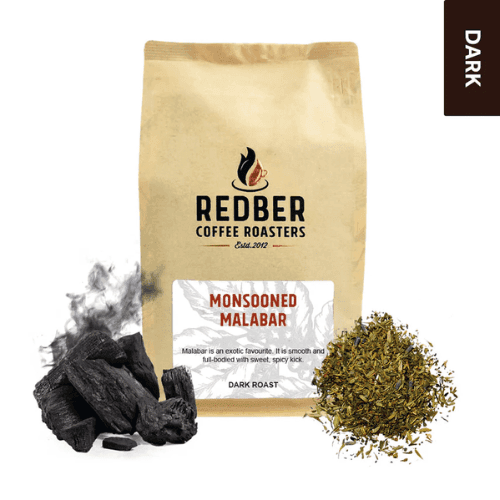
Rich, smoky and earthy coffee with a monotone smoothness and a sweet spicy kick.
Du wirst zum Shop der Rösterei weitergeleitet, um den Kauf abzuschließen.
Verfügbare Varianten
| Grind | Coffee Size | Preis |
|---|---|---|
| Whole Beans | 250 gr | 7,09 $ |
| Whole Beans | 8kg | 141,00 $ |
| Whole Beans | 6kg | 111,00 $ |
| Whole Beans | 12kg | 202,00 $ |
| Whole Beans | 500 gr | 12,00 $ |
| Whole Beans | 1kg | 20,00 $ |
Details
- Aroma
- A balanced and delicious taste
- Säure
- Balanced
- Mahlgrad
- Ganze Bohne
- Röstgrad
- Dunkel
- Bohnensorte
- Arabica
- Intensität
- Intensiv
- Koffeingehalt
- Alle Kaffees
- Zertifizierung
- Bio Kaffee
- Zubereitungsart
- Kaffeebohnen für Vollautomaten
- Zusammensetzung
- Single Origin
- Herkunftsländer
- India
- Herstellungsland
- United Kingdom
Beschreibung
What you need to know...
- Flavours - earthy, spicy, smoky
- Aroma - spicy
- Body - medium / full
- Acidity - medium
Perfect for...
Espresso, americano, filter coffee.
The finer details...
- Origin: India
- Region: South India - Karnataka, Western Ghats
- Altitude: 1,100 -1,200 m above the sea level
- Variety: Kents, S.795, Catimor, Selection 9
- Harvest Period: October - February
- Processed Method: Dry Processed, Monsooned
Commercial cultivation of coffee in India began in 1840 when the British established coffee plantations throughout the mountains of Southern India. They found the tropical climate, high altitude, sunny slopes, ample rainfall, soil rich in humus content, and well drained sub soil ideal for coffee cultivation.
Indian coffee was historically shipped to Europe in wooden sailing vessels, taking four to six months to sail around the Cape of Good Hope before reaching their destinations. Coffee, stored below the water line and kept in a humid atmosphere by moisture seeping through the wood, underwent a form of treatment on its long voyage to market. When the coffee reached Europe, its colour had changed from bright green to pale gold and its new crop acidity had disappeared. This "Monsooning" process was later systematically replicated in India with the goal to consistently reproduce the familiar flavor from the historic voyages to the European ports.
The Monsooning process consists of exposing natural coffee beans in layers of 4-6 inch thickness to moisture-laden Monsoon winds in a well ventilated brick or concrete-floored warehouse. This process is carried out on the West Coast of India, making use of the winds from the Arabian Sea during the Southwest Monsoon months of June through September.
The processing begins with top grade beans, Arabica Cherry-AB, that has already been processed by the dry method. To equalise moisture absorption, the beans are raked frequently, followed by bulking and re-bagging at regular intervals. At the end of the monsoon season, this coffee is re-bulked, graded again, bagged and moved to a drier region for longer-term storage. In this 12-16 week process the beans absorb moisture in stages, swelling to nearly twice their original size and developing colours ranging from pale gold to light brown. The resulting coffee has a monotone smoothness with a sweet spicy kick. One of our best-loved and exotic coffees.
Bewertungen
Noch keine Bewertungen.