

 Presta costa rosters
Ethiopia Koke - Honey Process
Yirgacheffe, Éthiopie
- Honey
- Pure origine
Ethiopia Koke - Honey Process est un café d’origine Éthiopie, vendu par Presta costa rosters (Tucson, États-Unis). Région : Yirgacheffe. Traitement : honey. Variété : Kurume, Dega, Wolisho. Prix : de 24,00 $US à 130,00 $US, selon le format. Soit à partir de 57,32 $US le kilo.
Pas encore noté · Écrivez le premier avis
à partir de24,00 $US
≈ 57,32 $US / kg
Vous serez redirigé vers la boutique du torréfacteur pour finaliser votre achat.
- Pays du torréfacteur
- États-Unis
- Pays de livraison
- France · À vérifier sur la boutique du torréfacteur
Formats et prix
| Format | Au kg | Prix |
|---|---|---|
| 10oz | 84,66 $US | 24,00 $US ↗ |
| 2lb | 73,85 $US | 67,00 $US ↗ |
| 5lb | 57,32 $US | 130,00 $US ↗ |
Description
Region: Yirgacheffe
Farm: Smallholder Farms
Process: Honey
Varieties: Kurume, Dega, Wolisho
Elevation: 1800 meters
Coffee Production in Yirgacheffe:
Coffee grown in the many districts and kebeles of the Gedeo Zone is often referred to as Heirloom varieties, many of which were propagated and distributed to farmers in the last 40 years. Read more about common Ethiopian coffee varieties. Trees grow in red brown fertile soil under the shade of many tree species including Bibira, Cordia Africana, and the subsistence crop Ensete ventricosum.
In the southern region of Ethiopia, farmers pick coffee selectively, harvesting only ripe cherries individually by hand. Pickers rotate among the trees every eight to ten days, choosing only the cherries which are at peak ripeness. Many pickers average approximately 100 to 200 pounds of coffee cherries a day, which will produce 20 to 40 pounds of coffee beans. Each worker’s daily haul is carefully weighed, and each picker is paid on the merit of his or her work. The day’s harvest is then transported to the processing plant.
Washing Stations:
This lot of Koke Honey was sourced from a total of around 1200 smallholder farmers from Birbes Kela, Koke, Konga, Wedessa, and Tisho kebeles bring their harvested cherries for processing at the Koke and Birbes Kele washing stations.
Ally has a long-standing relationship with the Koke washing station, which was built in 2011 and has seen many improvements since 2015, when the washing station staff began providing guidance to contributing producers regarding steps to increase coffee quality.
The Birbes Kela washing station, located in the Birbes Kela kebele, is owned and operated
by Semira Negash. The site was founded in 2020 and operates as a vertically integrated
partner of Tracon, one of our exporting partners in Ethiopia. Shortly after opening her
washing station, Semira quickly established herself as a producer of high-quality coffees
with a strong placement in Ethiopia’s 2021 Cup of Excellence.
Honey Processing:
Harvested cherries are fermented in-cherry for two days prior to being pulped. The pulped coffee is then dried on raised beds to its optimal humidity.
Region Description:
Literally translated as “Land of Many Springs,” Yirgacheffe has the ideal topography, elevation, and water sources to produce and process exceptional coffees. Yirgacheffe is one of the woredas, a district like a municipality or county that includes many towns, of the Southern Nations, Nationalities, and Peoples Region (SNNPR) of Ethiopia. Yirgacheffe is part of the Gedeo Zone of SNNPR and the Yirgacheffe woreda is bordered to the south by Kochere, to the west by Oromia Zone, to the north by Wenago, to the east by Bule, and to the southeast by Gedeb. The Yirgacheffe woreda is 409km from Ethiopia’s capital of Addis Ababa and has a population of almost 200,000 people, less than 10% of whom live in cities.
Coffee farmers in Yirgacheffe are typically multi-generational, small-scale landholders, sometimes with only a few acres of land. Most coffees in Yirgacheffe are sold as cherry to centralized washing stations that help further separate flavor profiles. Many farmers also grow the subsistence crop enset ventricosum, also known as false banana. Yirgacheffe is considered by many to be the birthplace of coffee and the coffee trees grown in the region are a naturally occurring mix of heirloom varietals cultivated among other species in coffee gardens and coffee forests. Washed Coffee was introduced to Ethiopia in the 1970’s, and Yirgacheffe was the location of the first wet processing mill.
Questions sur Ethiopia Koke - Honey Process
D’où vient Ethiopia Koke - Honey Process ?
Origine : Éthiopie. Région : Yirgacheffe. Producteur : Smallholder Farms. Altitude : 1 800 m. Variété : Kurume, Dega, Wolisho.
Comment Ethiopia Koke - Honey Process est-il traité ?
Méthode de traitement : honey.
Combien coûte Ethiopia Koke - Honey Process ?
Prix : de 24,00 $US à 130,00 $US, selon le format. Soit à partir de 57,32 $US le kilo. Les prix viennent de la boutique et peuvent changer ; la boutique affiche le prix actuel.
Où acheter Ethiopia Koke - Honey Process ?
Dans la boutique en ligne de Presta costa rosters : les prix de cette page y renvoient. Cafendo ne vend pas de café.
Réponses tirées des données de la boutique et du catalogue Cafendo.
Avis
Aucun avis pour l’instant.
Si vous aimez ce café, essayez ceux-ci
Choisis chez d’autres torréfacteurs pour une origine, un procédé, une torréfaction, des notes et un prix en commun. Les cafés enregistrés ou bien notés par les mêmes personnes comptent le plus.
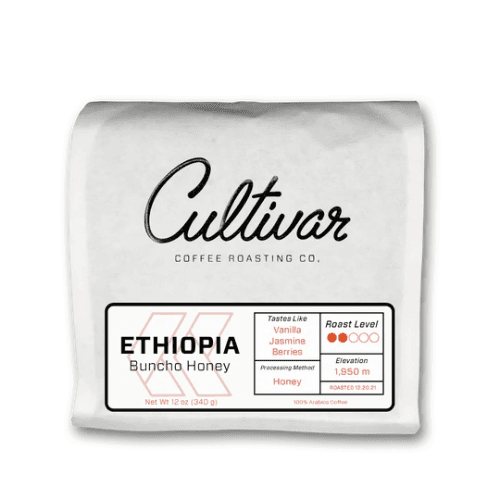
Cultivar Coffee
ETHIOPIA BUNCHO HONEY
17,77 $US
MoyennePourquoi: ÉthiopieHoneyPrix proche

The Right Roast
Reshad Ababulgu Ethiopia White Honey
22,63 £GB
Pourquoi: ÉthiopieHoneyPrix proche

Feast Coffee
Koke | Ethiopia | Honey
26,00 $US
Pourquoi: ÉthiopieHoneyPrix proche

Chrome Yellow
Ethiopia Koke Honey
21,95 $US
Pourquoi: ÉthiopieHoneyPrix proche

Paradigm Spark
Murago - Ethiopia Black-honey
22,95 $CA
Pourquoi: ÉthiopieHoneyPrix proche

French Truck Coffee
Ethiopia Honey
28,00 $US
Pourquoi: ÉthiopieHoneyPrix proche

Campbell & Syme
LALESA (BH), ETHIOPIA
16,50 £GB
Pourquoi: ÉthiopieHoneyPrix proche

MABÓ Coffee Roasters
NAZIMU ABAMECHA, Ethiopia (Honey)
79,00 RON
Pourquoi: ÉthiopieHoneyPrix proche


