


Thailand Exotic Microlot - Melanee Laechoeku Baan Sib Lang
Tajlandia
- Single origin
Thailand Exotic Microlot - Melanee Laechoeku Baan Sib Lang to kawa z kraju: Tajlandia, w sprzedaży u: Parchmen & Co (Singapur). Cena: od 8,00 SGD do 70,00 SGD, zależnie od opakowania. To od 70,00 SGD za kilogram.
Jeszcze bez ocen · Napisz pierwszą opinię
od8,00 SGD
≈ 70,00 SGD / kg
Przejdziesz do sklepu palarni, gdzie dokończysz zakup.
- Siedziba palarni
- Singapur
- Kraj dostawy
- Polska · Sprawdź w sklepie palarni
Warianty i ceny
| Mielenie | Wielkość opakowania | Za kg | Cena |
|---|---|---|---|
| Ziarnista | 50g | 160,00 SGD | 8,00 SGD ↗ |
| Mielona do espresso | 50g | 160,00 SGD | 8,00 SGD ↗ |
| Mielona do kawiarki | 50g | 160,00 SGD | 8,00 SGD ↗ |
| Mielona do przelewu | 50g | 160,00 SGD | 8,00 SGD ↗ |
| Mielona do French Pressa | 50g | 160,00 SGD | 8,00 SGD ↗ |
| Ziarnista | 150g | 80,00 SGD | 12,00 SGD ↗ |
| Mielona do espresso | 150g | 80,00 SGD | 12,00 SGD ↗ |
| Mielona do kawiarki | 150g | 80,00 SGD | 12,00 SGD ↗ |
Pokaż wszystkie (25)
| Mielenie | Wielkość opakowania | Za kg | Cena |
|---|---|---|---|
| Mielona do przelewu | 150g | 80,00 SGD | 12,00 SGD ↗ |
| Mielona do French Pressa | 150g | 80,00 SGD | 12,00 SGD ↗ |
| Ziarnista | 250g | 80,00 SGD | 20,00 SGD ↗ |
| Mielona do espresso | 250g | 80,00 SGD | 20,00 SGD ↗ |
| Mielona do kawiarki | 250g | 80,00 SGD | 20,00 SGD ↗ |
| Mielona do przelewu | 250g | 80,00 SGD | 20,00 SGD ↗ |
| Mielona do French Pressa | 250g | 80,00 SGD | 20,00 SGD ↗ |
| Ziarnista | 500g | 72,00 SGD | 36,00 SGD ↗ |
| Mielona do espresso | 500g | 72,00 SGD | 36,00 SGD ↗ |
| Mielona do kawiarki | 500g | 72,00 SGD | 36,00 SGD ↗ |
| Mielona do przelewu | 500g | 72,00 SGD | 36,00 SGD ↗ |
| Mielona do French Pressa | 500g | 72,00 SGD | 36,00 SGD ↗ |
| Ziarnista | 1kg | 70,00 SGD | 70,00 SGD ↗ |
| Mielona do espresso | 1kg | 70,00 SGD | 70,00 SGD ↗ |
| Mielona do kawiarki | 1kg | 70,00 SGD | 70,00 SGD ↗ |
| Mielona do przelewu | 1kg | 70,00 SGD | 70,00 SGD ↗ |
| Mielona do French Pressa | 1kg | 70,00 SGD | 70,00 SGD ↗ |
Opis
Sourced through Aligner Coffee
The hills and villages around Baan Sib Lhang rarely appear on maps; they exist instead through footpaths, family networks and the quiet continuity of agriculture. Baan Sib Lhang is a hamlet tucked between slopes of 900 to 1,300 metres, where the air is cool enough at night to slow cherry maturation.
The name “Baan Sib Lhang” carries the quiet poetry typical of rural Thai villages. In Thai, baan means village or home. Sib is “ten,” and lhang can mean “behind,” “after,” or “rear.” "Ban Sib Lang" literally means "Village of Ten Houses," a reference to the humble beginning of a handful of households that once made up the entire community before it grew into one of the most recognized names in Thai specialty coffee.
Baan Sib Lang is home to the Akha people, an indigenous hill tribe with a long-standing relationship to the forests and highlands of northern Thailand. Farming knowledge passed down through generations, combined with the high-altitude climate, has made this village well-suited to growing quality coffee. Farmers here cultivate mixed varieties like typica, catimor, catuai, bourbon and Chiang Mai 80, chosen not for trendiness but for resilience and familiarity. The soil is a mix of clay and loam, enriched by decades of organic matter from forest cover. Rain arrives in long showers and the slopes drain well, preventing the waterlogging that plagues lower valleys. All these conditions together give the cherries a slow, even ripening, setting the right conditions for sweetness and clarity in the cup.
Most families do not operate full processing stations; instead, they harvest cherries and sell them as fresh cherry or parchment to micro-roasters and small processors in Chiang Rai and Mae Hong Son. Among these farmers is Melanee Laechoeku, whose plot sits on one of the higher ridges. Her cherries are shaped by cooler nights and the steady mountain breeze that dries the morning dew.
At Baan Sib Lhang, coffee grows in mixed agroforestry plots, woven between banana, bamboo and fruit trees. Alongside coffee, the village also produces plum blossom (ume) honey, macadamia nuts, and avocados. Coffee remains the community's primary source of income, but it was the local plum blossom honey that gave rise to honey co-fermentation - a coffee fermentation process using local honey that turned an existing village resource into a signature characteristic of Ban Sib Lang's coffee.
In the honey co-fermentation, the cherries are washed, then depulped and fermented with plum blossom honey in a sealed tank for 168 hours, with pH monitored daily throughout the process.
Baan Sib Lhang has won national recognition, placing 9th and 10th in the SCATH (Specialty Coffee Association of Thailand) 2021 in the category of wash process.
Roast Level
The blend of beans of different characteristics makes balancing the roast a challenge. The roast tends to accelerate instantly after cracking, which transforms delicate flavour to a caramelly and chocolatey profile. Our strategy is a low ROR upon cracking, and allowing it to continue roasting for a long time as the ROR continue to decrease. We believe that the long time after crack develops the sweetness in the bourbon and catuai, whereas the low energy of the crack preserves the floral notes in the typica and the citrus notes in the catimor.
Brew Flavour
Grind size, brewer, kettle, filter paper, water characteristics, speed and height of pour - all these factors and probably more affect the final cup. We are cognizant that brew recipe can only serve as a guide.
We are using the Abaca paper on a Timemore Crystal Eye dripper, at 15g @ 750 μm to 200ml to brew this coffee. To contextualise the grind size, it is close to the size of sugar. On a 3-day-old roast, the dry fragrance is tropical fruits on a caramelly base, almost like pineapple tarts.
Since 2026, we have been experimenting with 2-part pour, using 2 temperatures. Our method is seldom practised in cafes as it is unfriendly towards training for the brewer's cup competition requiring serving 3 coffees simultaneously.
Our method is simple, as follows:
A shorter 1st part at a higher temperature followed by a longer 2nd part at a lower temperature. This is in recognition that enzymatic chemical compounds are smaller molecules that are easily extractable; these compounds produce our favorite notes of fruits and flowers, and are the first to be extracted. The first brewing water has to fight the interference of the escaping roasting gases that are getting out of the coffee particles as the water is trying to get in. A higher water temperature carries more energy to maximise the extraction of these enzymatic compounds. However, this first part will be more sour as it consists predominantly of easily extractable acids.
Subsequently, the longer time lapsed after the start of brewing allow capillary actions and diffusion to bring chemical compounds that are deeper inside the coffee particle to the surface to be eroded by the fresh brewing water. Again, the enzymatic smaller molecules will be more mobile and first to be extracted, contributing to the flavour profile of the brew. Adding to this will be the heavier and less mobile compounds, contributing sweet and then bitter notes to the brew. But because the human tongue is approximately 1 million times more sensitive to bitterness than sweetness, we choose to use a lower temperature but at a longer time (higher volume) to achieve a delicate flavour balance.
We experimented with high and low temperature brewing paired with finer (650 μm) and coarser (750 μm) grounds, With fine grounds at 93°C, the aroma profile is more closed but there is intense lime candy and spices (star anise or nutmeg) at various parts of the brew. With coarse grounds at 92°C, the aroma profiles opens up to clearer layers - blend of tropical fruits like the smell at a fruit store, orange peel, lime candy, honey when hot, turning into milk chocolate and flowers when cooler. Underlying these aromas are the sweetness, smooth mouthfeel and a pineapple acidity. The afterflavour is clean, reflecting the superiority of the processing.
This is our brew recipe, with 2 pours:
0th sec - Add 80g of 92°C water
(Within 5 days of roast) 45th sec for 30 sec - Add 140g of 89°C water to reach 220g
(After 5 days of roast) 30th sec for 30 sec - Add 140gof 89°C water to reach 220g
Bypass 5-10g if needed
Savouring our world in a cup!
Enjoy!
Pytania: Thailand Exotic Microlot - Melanee Laechoeku Baan Sib Lang
Thailand Exotic Microlot - Melanee Laechoeku Baan Sib Lang: skąd pochodzi?
Pochodzenie: Tajlandia.
Thailand Exotic Microlot - Melanee Laechoeku Baan Sib Lang: ile kosztuje?
Cena: od 8,00 SGD do 70,00 SGD, zależnie od opakowania. To od 70,00 SGD za kilogram. Ceny pochodzą ze sklepu i mogą się zmienić; aktualne są w sklepie.
Thailand Exotic Microlot - Melanee Laechoeku Baan Sib Lang: gdzie kupić?
W sklepie internetowym: Parchmen & Co; ceny na tej stronie do niego prowadzą. Cafendo nie sprzedaje kawy.
Opinie
Nie ma jeszcze opinii.
Jeśli lubisz tę kawę, spróbuj tych
Wybrane z innych palarni według wspólnego pochodzenia, obróbki, stopnia palenia, nut smakowych i ceny. Najwięcej znaczą kawy zapisane lub wysoko ocenione przez te same osoby.

Hannoversche Kaffeemanufaktur
Zoo Collection Tin - Pang Khon Thailand
9,95 USD
Średnio palonaDlaczego: TajlandiaPodobna cena
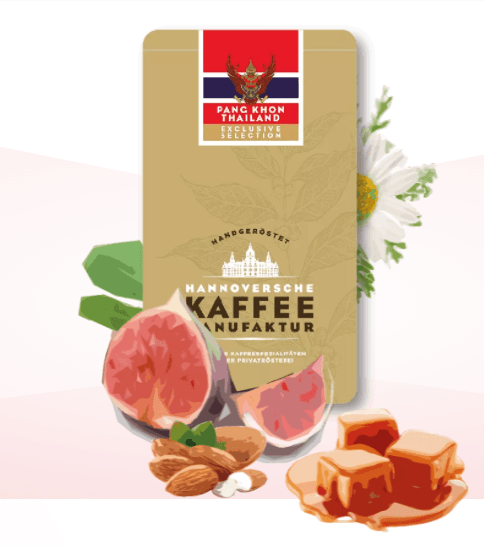
Hannoversche Kaffeemanufaktur
Pang Khon Thailand
9,50 USD
Średnio palonaDlaczego: TajlandiaPodobna cena
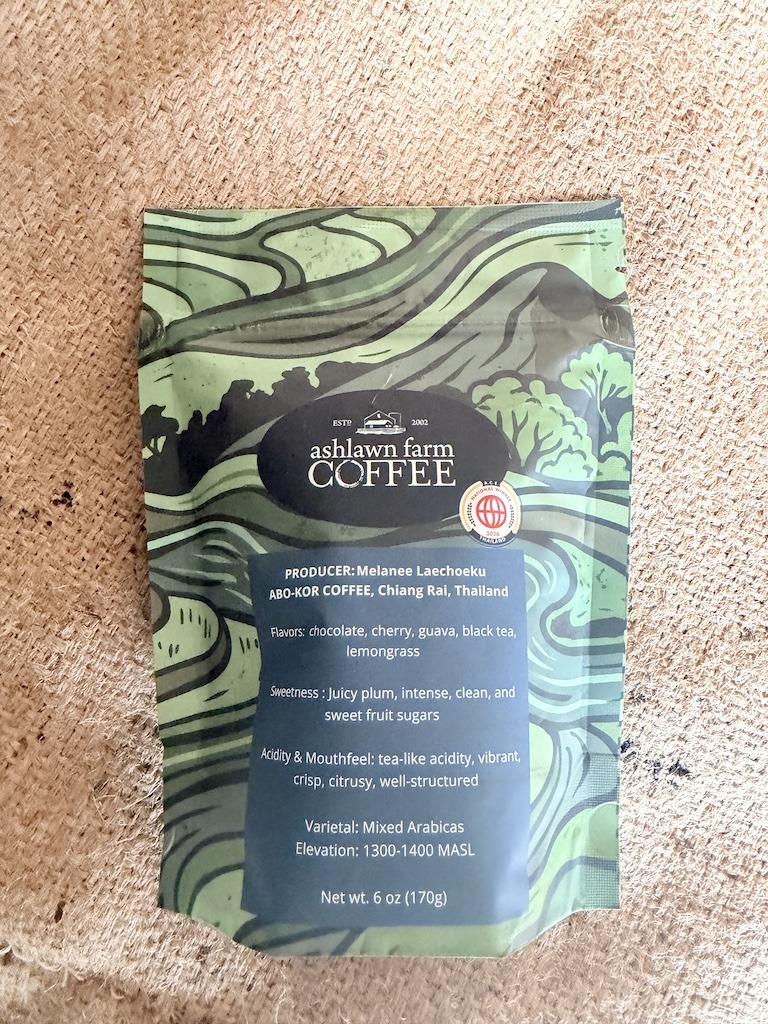
Ashlawn Farm Coffee
THAILAND, CHIANG RAI — NATIONAL WINNER 2026
5,50 USD
Dlaczego: TajlandiaPodobna cena

Cypher
Doi Tung – Rank 24 - Thailand
125,00 AED
Dlaczego: Tajlandia

Sarnies
Thailand, Kanchanaburi, Sartum Farm Fine Robusta Coffee Beans
25,00 SGD
Średnio palonaDlaczego: Tajlandia

Sarnies
Thailand, Chiang Rai, Mae Suai, Rom Yen, USDA Certified Organic Coffee Bean (Single Origin)
25,00 SGD
Średnio palonaDlaczego: Tajlandia

Quantum Coffee Roasters
THAILAND, Chiang Rai - Anaerobic honey
16,50 GBP
Średnio palonaDlaczego: Tajlandia

Ceresia Coffee Roasters
Mae Toey, Thailand
432,00 THB
Średnio palonaDlaczego: Tajlandia


