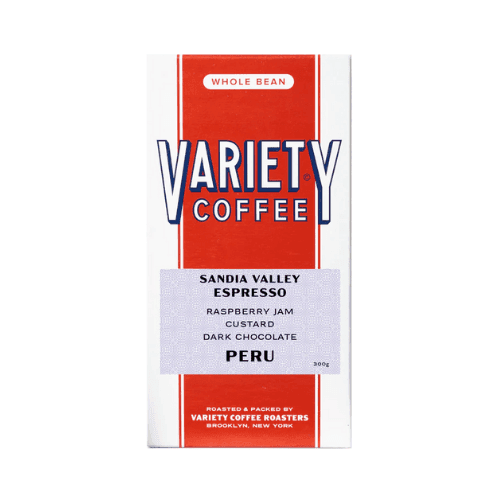
Sandia Valley Espresso
from$16.05
NOTES: Raspberry Jam, Custard, Dark Chocolate VARIETIES: Caturra, Bourbon, Typica ELEVATION: 1500-1800 masl PROCESS: Washed
You’ll be taken to the roaster’s shop to complete your purchase.
Available options
| Grind | Coffee Size | Price |
|---|---|---|
| Whole Beans | 300 g | $16.05 |
| Whole Beans | 5lb | $122.81 |
Details
- Flavor
- A balanced and delicious taste
- Acidity
- Balanced
- Caffeine
- Caffeinated Coffee
- Intensity
- Rather strong
- Composition
- Single Origin
- Roast Level
- Medium
- Coffee Grind
- Whole Bean
- Certification
- 100% Direct Trade Coffee
- Coffee Bean Type
- Arabica
- Preparation Mode
- Fully Automatic Machines Coffee
- Countries of Origin
- Peru
- Country of Manufacture
- United States
Description
Creamy and viscous with just a hint of brightness, this well-balanced roast is an excellent expression of what the Sandia Valley in Puno, Peru has to offer. With Peruvian coffees reaching their peak of depth and clarity, it's a wonderful time to feature this lot as our rotating Single Origin Espresso.
Within the massive Sandia Valley lie many smaller valleys, each hosting unique coffee-producing communities of smallholder farmers averaging just 2.5 hectares of coffee land, including Inambari, Tupac Amaru, and San Juan del Oro. Due to an UN-led replanting project in the 80s, much of Sandia Valley grows Bourbon-variety coffee, offering an elegant, floral, honeyed, and dynamically citric character, or, alternately, a rich, full-bodied, and incredibly sweet malic red apple or pear aspect. These coffees are entirely unique to Puno, distinct from what you’ll find in other regions of Peru, and offer something for every palate.
All of these farmers are small in terms of their landholding. The average farm size is 2.5 hectares with coffee trees as old as 8 years. The harvest period in Sandia, Puno is between July and September. They all use hand crank depulping machines, ferment in concrete tanks and wash in the same tanks. A few of them have channels for density separation after washing. The climate can be rainy, also similar to Colombia, so many producers use parabolic beds for drying. The cooperative also offers drying services at their receiving stations meaning that they’ll dry coffee to proper moisture levels for the farmers.
Reviews
No reviews yet.