November 5, 2026 · By Darius Stan
How decaf coffee is made: Swiss Water, CO₂ and solvents
Decaf has a reputation problem: flat, papery, a coffee for people who do not really like coffee. That reputation comes from years of old beans and careless processing. Today many specialty roasters sell decaf that tastes like what it is, good coffee, just without most of the caffeine. How the caffeine comes out makes a real difference, so it is worth knowing the methods.
How much caffeine is left in decaf?
Decaf is not caffeine-free. In the EU, decaffeinated roasted coffee may contain at most 0.1% caffeine in the dry coffee; in the United States, the common standard is that at least 97% of the caffeine has been removed. In practice a cup of decaf usually holds a few milligrams of caffeine, compared with roughly 60 to 120 mg in a regular cup. For context, see caffeine per cup.
When does decaffeination happen?
Always on the green, unroasted beans, usually in specialised plants near the ports or in the producing countries, not at the roastery. Every method follows the same idea: the beans are soaked or steamed so they swell and the caffeine can move, the caffeine is drawn out with a solvent, water or carbon dioxide, and the beans are dried again before roasting. The hard part is taking out the caffeine while leaving the hundreds of compounds that make coffee taste like coffee.
The four main methods
Swiss Water Process (water only)
The beans are soaked in a "green coffee extract", water already saturated with the soluble compounds of coffee except caffeine. Because the water is full of flavour compounds, mostly the caffeine moves out of the beans. The extract is then filtered through activated carbon to catch the caffeine and reused. No chemical solvents are used, which is why many specialty roasters choose it. A similar method, the Mountain Water Process, is used in Mexico.
CO₂ method (supercritical carbon dioxide)
Moistened beans are put under high pressure with carbon dioxide in a state between gas and liquid. In that state CO₂ binds caffeine quite selectively. The caffeine is then separated and the CO₂ reused. The method was developed in Germany in the 1970s, keeps flavour well and is suited to large volumes.
Ethyl acetate ("sugarcane process")
Ethyl acetate is a compound that occurs naturally in fruit. In the sugarcane process, common in Colombia, it is made by fermenting sugarcane; the beans are steamed, rinsed with the ethyl acetate solution, then steamed again to remove it. Fans like its sweet, fruity results; it is sometimes called "natural decaf".
Methylene chloride (dichloromethane)
The most efficient solvent, used for much commercial decaf. It evaporates at around 40 °C, and roasting at over 200 °C removes the rest; legal limits on residues are strict in the EU. Some drinkers still prefer to avoid it, so many specialty roasters state their method on the bag.
Does decaf taste different?
A little. Every method removes some flavour compounds along with the caffeine, and decaffeinated beans are darker and more porous, so they roast faster and age faster. Good decaf starts with good green coffee and a careful roast. Tips:
- Look for the method on the bag (Swiss Water, CO₂, sugarcane).
- Buy whole beans and smaller bags; decaf goes stale faster.
- Single-origin decafs from Colombia, Peru or Mexico are common, and many taste of chocolate and caramel.
- For a bean-to-cup machine, use the powder chute for an occasional decaf, or see beans for bean-to-cup machines.
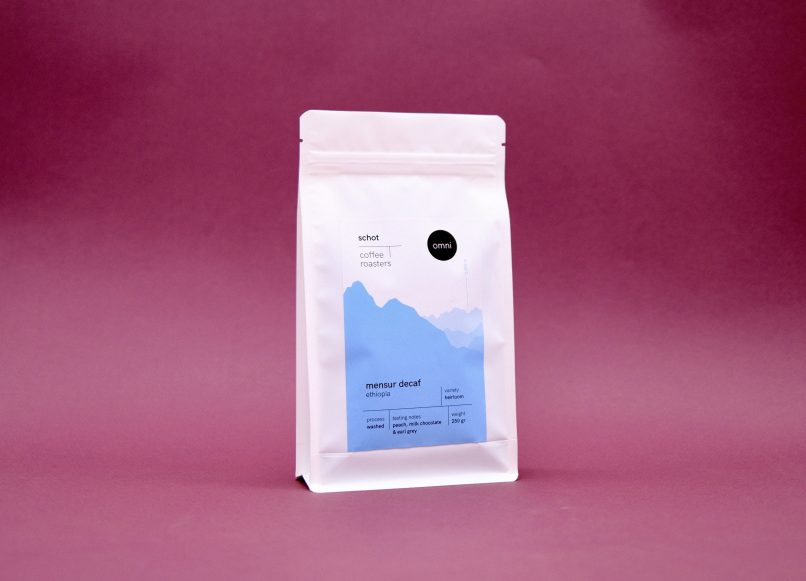
Browse all decaffeinated coffee in the catalog, or search for Swiss Water decaf.
Naturally low-caffeine coffee
A few arabica varieties contain naturally less caffeine, the best known being Laurina (Bourbon Pointu), with roughly half the caffeine of typical arabica. They are rare and usually expensive, but show that "less caffeine" does not have to mean processing.
A short history
The first commercial decaffeination process was patented in Germany in the early 1900s by Ludwig Roselius, founder of Kaffee HAG. It used benzene, a solvent long since abandoned. The safer solvent, water and CO₂ methods replaced it during the 20th century.
Quick answers
Is decaf coffee caffeine-free?
No, but close: usually a few milligrams per cup.
Which decaf method is best?
For taste, a well-done Swiss Water, CO₂ or sugarcane decaf can all be excellent. If you want to avoid chemical solvents, choose Swiss Water, Mountain Water or CO₂.
Can I make espresso with decaf?
Yes. Decaf beans often need a slightly finer grind; see the grind size chart.
From the catalog
From independent roasters and makers. Each one links to the shop that sells it.