


Chine - Tianhao
Lancang County, Pu’er City, Yunnan Province, China
- Natural
- Single Origin
Not rated yet · Be the first to review it
from€18.00
You’ll be taken to the roaster’s shop to complete your purchase.
- Roaster based in
- France
- Ship to
- United States · ✓ Yes, according to the roaster’s shop
Taste profile
From the details listed by the roaster’s shop.
Tasting notes
- Cherries
- Pineapple
- Rum
- Cocoa beans
Sizes and prices
| Grind | Torréfaction | Price |
|---|---|---|
| Whole Beans | Filtre | €18.00 ↗ |
| Ground-Espresso | Filtre | €18.00 ↗ |
| Ground (AeroPress) | Filtre | €18.00 ↗ |
| Ground (French Press) | Filtre | €18.00 ↗ |
| Mouture cafetière italienne | Filtre | €18.00 ↗ |
| Mouture V60 | Filtre | €18.00 ↗ |
| Mouture kalita | Filtre | €18.00 ↗ |
| Mouture cafetière filtre | Filtre | €18.00 ↗ |
Show all 9
| Grind | Torréfaction | Price |
|---|---|---|
| Mouture chemex | Filtre | €18.00 ↗ |
Description
Origin: China
Region: Lancang County, Pu’er City, Yunnan Province
Process: Natural
Varieties: Catimor
Farm: Tianhao Estate
Altitude: 1600m - 1800m
Tasting notes: Cherries, pineapple, rum, cocoa beans
In the heart of the Lancang Mountains, in Nanxiong Xinzai village (Huimin Township, Pu’er Prefecture), lies an estate shrouded in mist and history: Tianhao Estate.
It was founded in 2007 by Ms. Wei Yunhua (魏云华), who had begun planting coffee trees there in 2006. What began as nothing more than a bold idea has grown into an estate spanning 2.67 million square meters, with more than nineteen years of cultivation behind it.
At the time, villagers still considered coffee trees distant cousins of tea plants. Local Catimor plants swayed on the slopes, unnoticed and ignored. No one imagined then that this hillside would one day become one of Yunnan’s most renowned coffee estates.
Ms. Wei arrived with an unwavering vision: to grow coffee using ecological and sustainable methods. No pesticides, just biological pest control, homemade organic fertilizers, and the patience of the mountain wind. True to this philosophy, varieties such as Catimor and Geisha took root and began their quiet work.
The estate did more than grow coffee. It built its own processing facilities, allowing the journey from cherry to bean to take place entirely on the mountain. Bringing cultivation and processing together in one place ensured that every lot preserved the integrity of its origin, without compromise.
Years ago, when someone suggested treating the cherries like wine grapes, the idea seemed bold, almost unconventional. They spread the ripe fruit on raised drying beds, covered it with a tarp, and let fermentation take place through the skin.
The first roast filled the air with aromas of raisins, honey, and a subtle wine-like note. Some furrowed their brows. Others were left speechless. Someone eventually laughed and said, “These beans could almost get you drunk.”
The news spread through the valleys faster than the wind. Roasters and baristas began taking the winding road to see it for themselves. They tasted the coffees, noting flavors of cocoa, wine, sweetness, and purity, while sometimes saying, “This isn’t quite Yunnan, and yet it’s unmistakably Yunnan.”
At dawn, sunlight still strikes the drying beds as it always has. The cherries take on an amber hue, the air fills with sweetness, and the villagers like to joke that when the wind blows outward, even the birds seem to taste different.
Tianhao never tries to make a name for itself, but people always end up discovering it. Is it thanks to the terroir? The processing method? Or is it simply the result of an approach that refuses to rush, letting the mountain speak through the beans?
Tianhao never set out to become a legend; it simply became one.
Yunnan coffee cherries are naturally rich in sugars and pectin—the best lots reach 16 to 17 °Brix at harvest. This natural advantage gave rise to a regional signature called “Winey Natural,” a method shaped by the local terroir that recalls cold maceration in winemaking. It gives the cup a balanced, wine-like character while preserving the purity of its origin.
Only perfectly ripe, sugar-rich red cherries are selected and carefully washed before undergoing low-temperature natural fermentation in airtight tanks. Under strict control, soluble solids decrease from 16–17 °Brix to around 8 °Brix as the sugars are transformed—through lactic and acetic metabolic pathways—into a complex range of esters and fruity aromas.
After fermentation, the cherries are dried with their skins and mucilage intact, either continuously or in carefully controlled stages under the Yunnan sun, concentrating sweetness and stabilizing the aromas.
Once drying is complete and the optimal moisture level is reached, the coffee is hulled and then sorted optically with the help of artificial intelligence to remove defects and impurities, ensuring a clean and consistent expression.
Reviews
No reviews yet.
Similar coffees
From China, by other roasters
CaffèLab
Caffelab CHINA Meng Meng
$11.00
CaffèLab
Caffelab CHINA Meng Meng
$11.00
Dark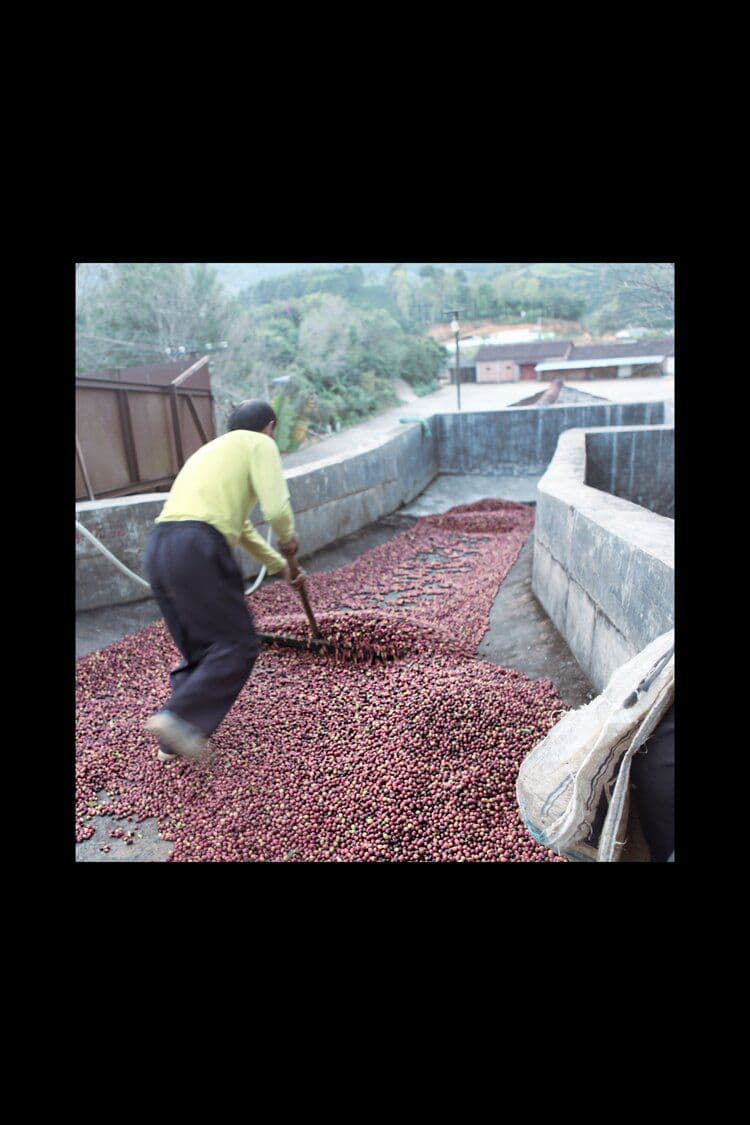
ASIP Coffee Roasters
Yunnan Fuyan
$15.85

Fortnum & Mason
Yunnan Lijiang Coffee Beans, 125g
$21.47
Medium
Carrara Coffee Roasters
No Stone Estate, China - Bergamot Enzyme Honey
£19.00
CafédirectCommercial brand
China Banka Yunnan
$9.95
Medium
MalongoCommercial brand
COFFEE BEANS CHINA SIMAO
$5.80
Medium


