


Thailand Exotic Microlot - Suphanat Kuntawang Aligner Coffee Anaerobic Natural
Thailand
- Anaerobic
- Single Origin
Thailand Exotic Microlot - Suphanat Kuntawang Aligner Coffee Anaerobic Natural is a coffee from Thailand, sold by Parchmen & Co (Singapore). Process: anaerobic. Price: SGD 8.00 to SGD 70.00, depending on the size. That is from SGD 70.00 per kilo.
Not rated yet · Be the first to review it
fromSGD 8.00
≈ SGD 70.00 / kg
You’ll be taken to the roaster’s shop to complete your purchase.
- Roaster based in
- Singapore
- Ship to
- United States · Check on the roaster’s shop
Sizes and prices
| Grind | Coffee Size | Per kg | Price |
|---|---|---|---|
| Whole Beans | 50g | SGD 160.00 | SGD 8.00 ↗ |
| Ground-Espresso | 50g | SGD 160.00 | SGD 8.00 ↗ |
| Ground (Moka) | 50g | SGD 160.00 | SGD 8.00 ↗ |
| Ground-Filter | 50g | SGD 160.00 | SGD 8.00 ↗ |
| Ground (French Press) | 50g | SGD 160.00 | SGD 8.00 ↗ |
| Whole Beans | 150g | SGD 80.00 | SGD 12.00 ↗ |
| Ground-Espresso | 150g | SGD 80.00 | SGD 12.00 ↗ |
| Ground (Moka) | 150g | SGD 80.00 | SGD 12.00 ↗ |
Show all 25
| Grind | Coffee Size | Per kg | Price |
|---|---|---|---|
| Ground-Filter | 150g | SGD 80.00 | SGD 12.00 ↗ |
| Ground (French Press) | 150g | SGD 80.00 | SGD 12.00 ↗ |
| Whole Beans | 250g | SGD 80.00 | SGD 20.00 ↗ |
| Ground-Espresso | 250g | SGD 80.00 | SGD 20.00 ↗ |
| Ground (Moka) | 250g | SGD 80.00 | SGD 20.00 ↗ |
| Ground-Filter | 250g | SGD 80.00 | SGD 20.00 ↗ |
| Ground (French Press) | 250g | SGD 80.00 | SGD 20.00 ↗ |
| Whole Beans | 500g | SGD 72.00 | SGD 36.00 ↗ |
| Ground-Espresso | 500g | SGD 72.00 | SGD 36.00 ↗ |
| Ground (Moka) | 500g | SGD 72.00 | SGD 36.00 ↗ |
| Ground-Filter | 500g | SGD 72.00 | SGD 36.00 ↗ |
| Ground (French Press) | 500g | SGD 72.00 | SGD 36.00 ↗ |
| Whole Beans | 1kg | SGD 70.00 | SGD 70.00 ↗ |
| Ground-Espresso | 1kg | SGD 70.00 | SGD 70.00 ↗ |
| Ground (Moka) | 1kg | SGD 70.00 | SGD 70.00 ↗ |
| Ground-Filter | 1kg | SGD 70.00 | SGD 70.00 ↗ |
| Ground (French Press) | 1kg | SGD 70.00 | SGD 70.00 ↗ |
Description
Pai is a town in the Mae Hong Soon Province of northern Thailand. It is the northeasternmost district (amphoe) of the province. The central town is also named Pai. Sitting in a valley on the banks of the Pai River, it is known for its nearby gorges, hot springs and waterfalls. Downtown, food stalls and handicraft shops line Pai Walking Street. West of town lies a traditional Chinese village with clay houses and eateries serving Yunnan cuisine.
Coffee arrived almost by accident to Pai - just a handful of Arabica seedlings planted along the edge of a corn field in thePai valley floor. Pai’s basin sits between 400–500 metres - almost too low for arabica coffee - while the surrounding mountains rise to 800–1,600 metres. No one expected coffees there to thrive, yet the trees rooted themselves deeply, their leaves staying glossy even through the dry season. Over time, the cherries ripened into a deep, winey red, foretelling an unexpected coffee future that Pai has yet to become.
Years later, Suphanat Kuntawang (Nat is the shorthand and nickname) returned to Pai after studying mechanical design in Chiang Mai. He had spent years learning how to align gears, calibrate tolerances, and tune machines. But he aspired not a factory life but one that is more alive. When he tasted specialty coffee for the first time, he felt the same spark he felt when a machine snapped perfectly into alignment. Coffee was engineering disguised as agriculture, a system of variables waiting to be tuned. That realisation soon bore fruits. Nat built a roastery. He called itAligner Coffee - not because of teeth, as most would joke, but because he believed coffee was a chain of alignments: soil to seed, farmer to tree, roaster to bean, drinker to cup. Nat has a personal reason for this choice of name - it comes from his favourite song Miracle Aligner by The Last Shadow Puppets.
Nat partnered with the family who still tended those original Arabica trees. Together they transformed the small estate into a place of experimentation and a small processing facility. Raised beds made from reclaimed teak lined the slopes. Shade trees were planted in deliberate patterns to control light and sunburn at this low elevation. Microlots were separated by cultivar and angle of the hillside. Fermentation tanks were fitted with digital thermometers, and a solar dryer shaped like a greenhouse observatory became the centerpiece of the farm. Visitors who wandered in expecting a simple café found a working classroom instead, where farmers learned to measure Brix levels, adjust drying protocols and cup coffee with confidence.
The roastery itself was modest - a concrete room behind a bamboo fence, with a 1kg electric roaster and a whiteboard covered in roast curves. Nat roasted in small batches because he wanted every roast to be a conversation with the beans. Locals began calling him the kid who roasted like a scientist, though Nat always insisted he was simply trying to tell a story through flavor. Every cup carried the history of stubborn trees, careful hands, and a roaster who believed precision could reveal emotion. Tourists brought bags home, farmers brought cherries to learn new techniques, and baristas traveled from Chiang Mai to cup experimental batches. Slowly, Aligner Coffee became more than a roastery. It became a bridge connecting farmers with roasters, tradition with innovation, and the quiet hills of Pai with the wider world of specialty coffee. This lot is processed by Nat as a mixed blend, sourced as cherries from neighbouring farms.
Nat dreams of building a training centre where young farmers can learn roasting, fermentation science and sensory evaluation. He imagines Mae Hong Son becoming an origin recognised for its clarity, sweetness, and mountain-grown elegance. As long as the land continues to respond, Aligner Coffee will keep aligning - one seed, one roast, one story at a time.
Roast Level
The blend of beans of different characteristics makes balancing the roast a challenge. The roast tends to accelerate instantly after cracking, which transforms delicate flavour to a caramelly and chocolatey profile. Our strategy is a low ROR upon cracking, and allowing it to continue roasting for a long time as the ROR continue to decrease. We believe that the long time after crack develops the sweetness in the bourbon and catuai, whereas the low energy of the crack preserves the floral notes in the typica and the citrus notes in the catimor.
Brew Flavour
Grind size, brewer, kettle, filter paper, water characteristics, speed and height of pour - all these factors and probably more affect the final cup. We are cognizant that brew recipe can only serve as a guide.
We are using the Abaca paper on a Timemore Crystal Eye dripper, at 15g @ 800 μm to 220ml to brew this coffee. To contextualise the grind size, it is close to the size of sugar. On a 3-day-old roast, the dry fragrance is a sugary with yellow fruit characteristics.
Since 2026, we have been experimenting with 2-part pour, using 2 temperatures. Our method is seldom practised in cafes as it is unfriendly towards training for the brewer's cup competition requiring serving 3 coffees simultaneously.
Our method is simple, as follows:
A shorter 1st part at a higher temperature followed by a longer 2nd part at a lower temperature. This is in recognition that enzymatic chemical compounds are smaller molecules that are easily extractable; these compounds produce our favorite notes of fruits and flowers, and are the first to be extracted. The first brewing water has to fight the interference of the escaping roasting gases that are getting out of the coffee particles as the water is trying to get in. A higher water temperature carries more energy to maximise the extraction of these enzymatic compounds. However, this first part will be more sour as it consists predominantly of easily extractable acids.
Subsequently, the longer time lapsed after the start of brewing allow capillary actions and diffusion to bring chemical compounds that are deeper inside the coffee particle to the surface to be eroded by the fresh brewing water. Again, the enzymatic smaller molecules will be more mobile and first to be extracted, contributing to the flavour profile of the brew. Adding to this will be the heavier and less mobile compounds, contributing sweet and then bitter notes to the brew. But because the human tongue is approximately 1 million times more sensitive to bitterness than sweetness, we choose to use a lower temperature but at a longer time (higher volume) to achieve a delicate flavour balance.
This coffee is forward on tangerine - in aroma and in mouthfeel like a juice - with a base of sugar browning compunds - dark chocolate, roasted nuts and caramel. This is achieved with a fine grind size of 700 μm and 92°C, with a surprisingly clean afterflavour and additional floral aroma. On a finer grind size of 650 μm and 93°C, the aroma is dominated by nuts with a coarser mouthfeel. On a final recipe of 700 μm and 91°C for 200ml with 5ml bypass, the aromas are tangerine, almond butter and flowers, with a milky afterflavour that reminds us of caffe latte.
This is our brew recipe, with 2 pours:
0th sec - Add 80g of 92°C water
(Within 5 days of roast) 45th sec for 30 sec - Add 140g of 86°C water to reach 220g
(After 5 days of roast) 30th sec for 30 sec - Add 140gof 86°C water to reach 220g
Bypass 5-10g if needed
Savouring our world in a cup!
Enjoy!
Questions about Thailand Exotic Microlot - Suphanat Kuntawang Aligner Coffee Anaerobic Natural
Where does Thailand Exotic Microlot - Suphanat Kuntawang Aligner Coffee Anaerobic Natural come from?
It comes from Thailand.
How is Thailand Exotic Microlot - Suphanat Kuntawang Aligner Coffee Anaerobic Natural processed?
Processing method: anaerobic.
How much does Thailand Exotic Microlot - Suphanat Kuntawang Aligner Coffee Anaerobic Natural cost?
Price: SGD 8.00 to SGD 70.00, depending on the size. That is from SGD 70.00 per kilo. Prices come from the shop and can change; the shop has the current ones.
Where can I buy Thailand Exotic Microlot - Suphanat Kuntawang Aligner Coffee Anaerobic Natural?
In the online shop of Parchmen & Co: the prices on this page link to it. Cafendo does not sell coffee itself.
Reviews
No reviews yet.
If you like this coffee, try these
Picked from other roasters for a shared origin, process, roast, tasting notes and price. Coffees that the same people saved or rated highly count the most.

Quantum Coffee Roasters
THAILAND, Chiang Rai - Anaerobic honey
£16.50
MediumWhy: ThailandAnaerobic

Lanna Coffee Co.
Thailand Law Wu Anaerobic Washed
$20.00
MediumWhy: ThailandAnaerobic

Royal mile
Thailand Anaerobic Mai Khun
$25.00
Why: ThailandAnaerobic

Flight Coffee
Doi Saket - Thailand - Anaerobic Natural
NZ$24.00
Why: ThailandAnaerobic

Five Oars Coffee Roasters
Mae Chedi AH
SGD 22.94
Why: ThailandAnaerobic

Hannoversche Kaffeemanufaktur
Zoo Collection Tin - Pang Khon Thailand
$9.95
MediumWhy: ThailandSimilar price
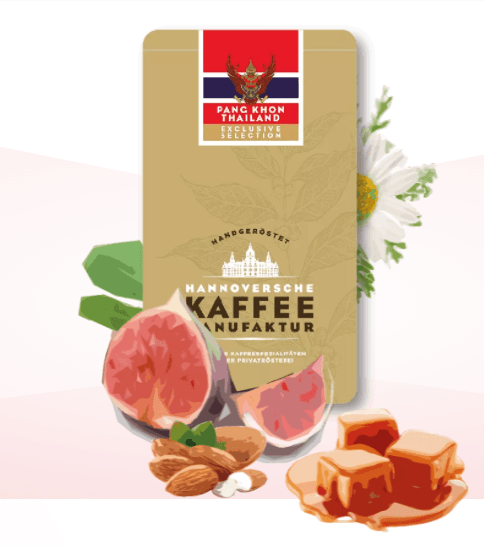
Hannoversche Kaffeemanufaktur
Pang Khon Thailand
$9.50
MediumWhy: ThailandSimilar price
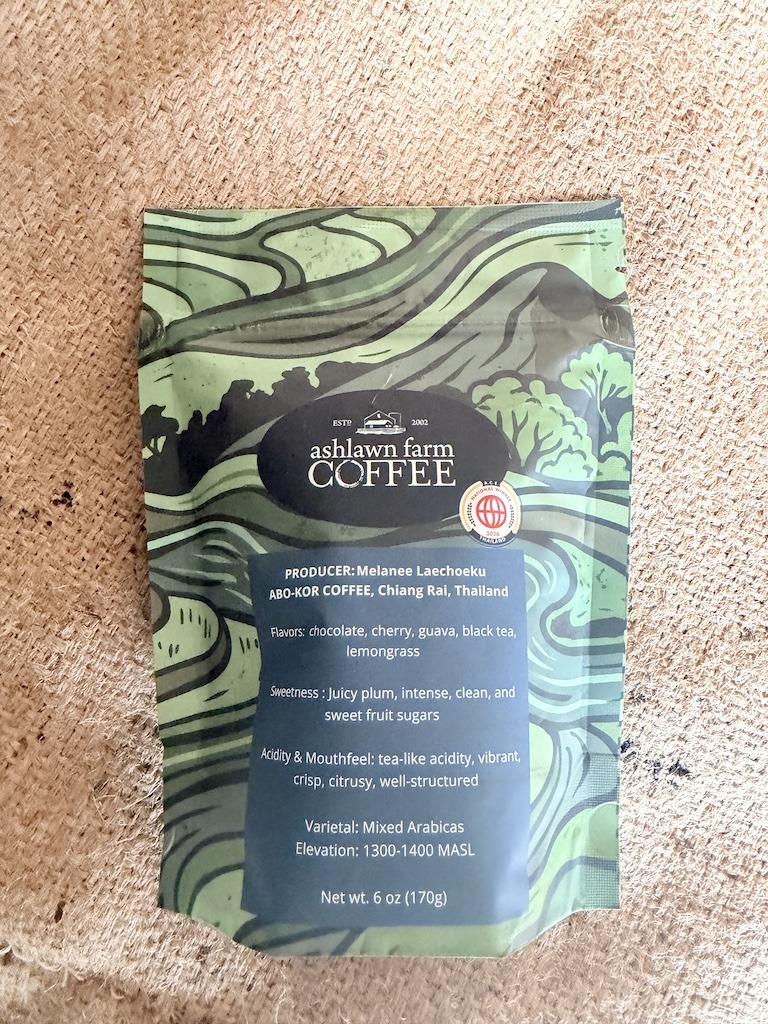
Ashlawn Farm Coffee
THAILAND, CHIANG RAI — NATIONAL WINNER 2026
$5.50
Why: ThailandSimilar price


